

Collaboration is key to realising product circularity
2026-09-28

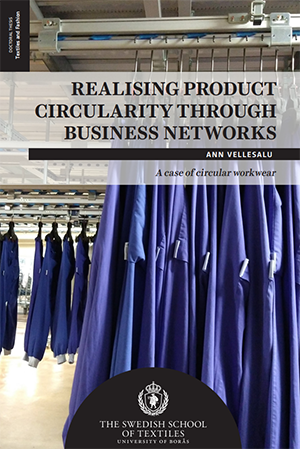
Product circularity can be realised through collaboration between companies and other societal actors. In the thesis Realising product circularity through business networks: A case of circular workwear, Ann Vellesalu shows how product circularity can be understood and implemented through cooperation between different organisations and what consequences this has for business networks.
 "Previous research tends to treat development, production, and use as separate and sequential parts of a product’s life cycle. In addition, the focus has largely been on the efforts of individual companies. This thesis contributes a perspective in which product circularity is instead understood as something that is created through relationships between multiple actors and at several levels of society," said Ann Vellesalu.
This involves a focus on the whole product lifecycle, as well as considering collaboration across different levels. The results of her study show that the interplay between resource use, relationships between organisations, and the work carried out to influence regulations, norms, and ways of working is of great importance in creating both stability and change within business networks.
Two case studies on workwear
The research is based on two qualitative case studies and one conceptual study. The first case study focuses on the development and production of workwear within healthcare services. The second examines the use of workwear within the construction and manufacturing industries, she said.
"Through the case studies, it was possible to identify patterns of collaboration that can both enable and hinder product circularity. The conceptual study complements the results by analysing how knowledge of the structure and processes of business networks can help address common challenges in the transition to a circular economy," she explained.
Practical guidance for the transition
"The results provide practical insights for the workwear sector, particularly for manufacturers, service providers, and customers who want to implement changes while maintaining stability in their operations."
The research provides guidance on which relationships may need to be prioritised, how related risks can be managed, and how increased collaboration between organisations can be supported. For decision-makers, the results indicate how the transition to a circular economy can be promoted through greater resource efficiency at product level and by strengthening the links between the business networks responsible for development, production, and use.
Link to the UN Sustainable Development Goals
The results of the thesis contribute to the United Nations Sustainable Development Goals, primarily Goal 12 on responsible consumption and production. By highlighting how product circularity can be realised through increased resource efficiency and longer product lifespans, the research supports the targets relating to sustainable resource management and reduced waste.
Ann Vellesalu defended her doctoral thesis in textile management on 25 September with the title Realising product circularity through business networks: A case of circular workwear.
Supervisor: Daniel Hjelmgren, Docent
Assistant Supervisors: Nicklas Salomonson, Professor, and Olga Chkanikova, Senior Lecturer
Opponent: docent Lisa Govik, Chalmers University of Technology
Solveig Klug
Adobestock