

Julia’s aim: to work on projects that combine creativity, technology, and new materials
What did you do before you started studying at The Swedish School of Textiles?
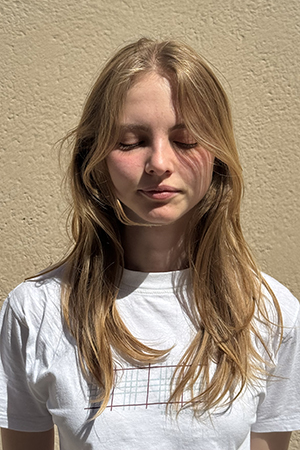 "I studied at the Hetzendorf Fashion School in Vienna, where I specialised in millinery. After that, I knew I wanted to expand my skills beyond millinery and learn more about other areas within fashion."
What do you do on the programme?
"It really depends on the course, but I would say we spend a lot of time exploring the different labs (weaving, knitting, printing, tufting, sewing, and digital technologies) and experimenting with the techniques and materials available to us. We then use what we learn to create projects related to each course."
What is the best thing about the programme?
"The freedom to create what we want and explore our own ideas. The teachers and technicians are also very supportive and help us bring our ideas and visions to life."
What can you work with after completing the programme?
"There are many different possibilities, from working as a fashion designer or developing your own brand to exploring areas such as digital fashion, textile design, or creative research."
What would you like to do after completing the programme?
"I would like to find my own direction as a designer. I am especially interested in the connection between physical and digital fashion, and I would love to work on projects that combine creativity, technology, and new materials."
Why should you study at The Swedish School of Textiles?
"There is a really good creative atmosphere at the school, both between students and among the teaching staff. You feel supported in developing your ideas, and if you’re interested in textiles and want to learn more about materials and techniques, it’s a great place to study. Besides that, the labs are well equipped, and every design student has their own workspace. The school is also open all day, which gives you a lot of flexibility and time to work on your projects whenever you want."
What is the student city of Borås like?
"Borås is a really cosy, smaller city surrounded by nature and beautiful lakes. It might take a little time to get used to it at first, but soon you start to feel at home here. The city also has a history in the textile industry, which makes it a particularly interesting place in which to study fashion."
You participated in the CLO EUROPE Rising Talent Award in 2026 and received an honourable mention for your work. What did you do?
"I participated in the Beyond Fashion category with the topic ‘Mycelium Bytes’. For me, it was about the connection between the physical and virtual worlds. Using CLO3D, I created a spiderweb-like structure that extended beyond the body and gradually melted into the background. I wanted to show how the digital world connects us to the physical world while also isolating us from it."
What does it mean to you to receive this award?
"It means a lot to have my work and effort recognised, especially through an award. I’m also grateful for the opportunity to attend the CLO Summit 2026 in Munich and meet other CLO3D users. As a student, it was really interesting to hear how they use the software in the industry, exchange thoughts, and learn about new features and future possibilities."