


How Can Small Website Design Adjustments Improve Sustainability Communication for SMEs?
2026-06-30

Background and purpose
Small- and medium-sized enterprises (SMEs) often face financial, human, and technical constraints that limit effective sustainability communication. In the textile and fashion industry, complex supply chains and certification systems further complicate how sustainability is communicated through digital platforms. Although frameworks such as the VSME standard provide structure for sustainability reporting, their application in website-based communication remains limited. While user-centered web design is widely recognised as important for improving information clarity and user experience, its application to sustainability communication remains underexplored.
Methodology
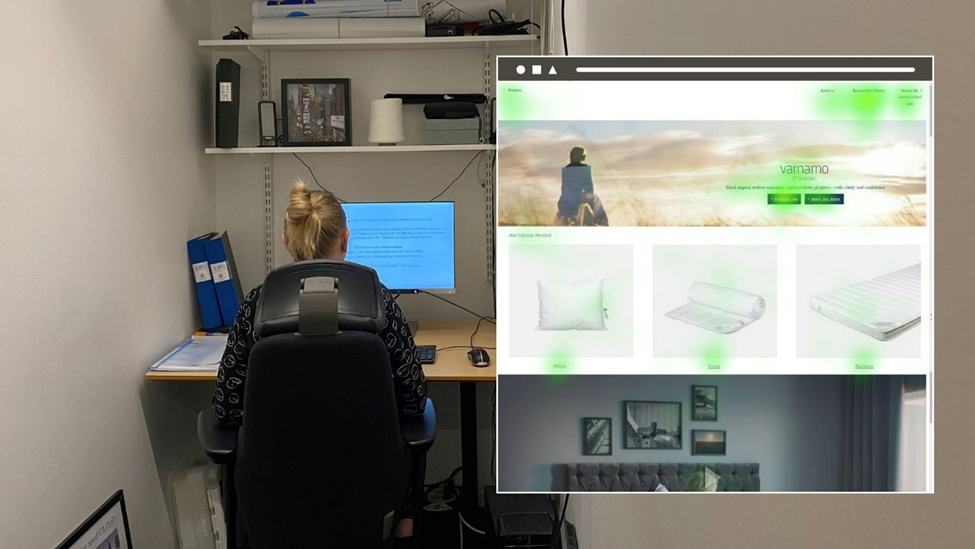
This study adopts a quantitative experimental design using a between-subject A/B test combined with screen-based eye-tracking and post-task questionnaires. A total of 22 participants were assigned to either an existing SME website (Version A) or a redesigned prototype (Version B). The redesign was guided by user-centered design principles, including visual hierarchy, F-pattern scanning behaviour, and content repetition strategies structured according to the VSME Basic Module. Eye-tracking metrics such as time to first fixation and page engagement, along with questionnaire measures of user perception (accessibility, clarity, and overall perception), were used to evaluate differences in user experience between conditions. Non-parametric statistical tests (Mann–Whitney U test) were applied due to the between-group design.
Result and Discussion
Through the eye-tracking results, I noticed clear differences in how users interacted with the two versions.
Visual Hierarchy:
- Participants noticed the top menu (Version B) faster than the bottom menu (Version A).
- Version B participants were more likely to actively interact after first fixation
- Version B, which used top navigation, enabled users to locate sustainability pages more quickly than Version A, which relied on bottom navigation.
- Version B demonstrated more consistent use of top navigation to access sustainability information, while Version A showed more varied and less consistent access paths.
Content Repetition and Comprehension:
- In both free browsing / search task, all Version B participants accessed more sustainability-related pages.
- In both free browsing / search task, Version B demonstrated more consistent user behaviour patterns.
- Questionnaire results showed higher ratings for Version B, but the differences were not significant.
In general, this study, conducted in a Swedish small-to-medium-sized textile company, shows that small, theory-driven design adjustments, rather than full website redesigns, can influence users’ visual attention speed, navigation behaviour, and exposure to sustainability-related information. The findings reveal a discrepancy between behavioural data and users’ subjective evaluations, as increased exposure was not consistently reflected in perceived accessibility.
Practical implications
From a business perspective, the results provide user-centred design insights for improving sustainability communication on corporate websites and offer SMEs with limited resources a design logic for developing sustainability communication through small-scale adjustments. From a methodological perspective, the discrepancy highlights the value of combining eye-tracking and navigation analysis with questionnaire-based measures, offering a reference for future mixed-method perceptual research. Variations in attention to sustainability-related content further suggest future research directions on how users interpret and associate different types of sustainability information in the textile context.
Project details
Type of Study: Conference Paper
Tagline: Exploring how small website design adjustments influence user interaction with sustainability information
Title: Improving SMEs’ Sustainability Communication Under Resource Constraints: A User-Centred Visual Design Approach Using the VSME Framework
Year: 2026
Author: Chieh-Liang Chang
Course: Field Study in Textile Management
Program: Master Programme in Fashion Marketing and Management
Supervisor/researcher: Lars Hedegård, Marianne Louwerse
Case company: Värnamo of Sweden
Technology: Screen-based eye-tracking
Chieh-Liang Chang