


Research Project: Future Circular Business Models – Designing Systems for Large-Scale Garment Repair
2026-07-01

Project Summary
The research project Future Circular Business Models – Designing Systems for Large-Scale Garment Repair is part of the transition towards a more circular textile industry. The project is led by the Swedish School of Textiles in Borås in collaboration with, among others, Chalmers University of Technology, Didriksons, RecoMended, and Science Park Borås, and is funded by the Swedish Energy Agency.
Today, a significant number of garments are discarded despite having only minor defects, resulting in unnecessary resource consumption. The project therefore focuses on identifying both opportunities and challenges in developing systems that make repair an integrated and scalable part of the commercial value chain.
A key aspect of the research is understanding how different parts of the system need to interact—from collection and sorting to repair, transportation, and retail presentation—in order to create functional circular business models.
The project also includes studies of consumer perceptions of repaired garments, for example through experiments and eye-tracking, with the aim of understanding what influences acceptance and willingness to pay.
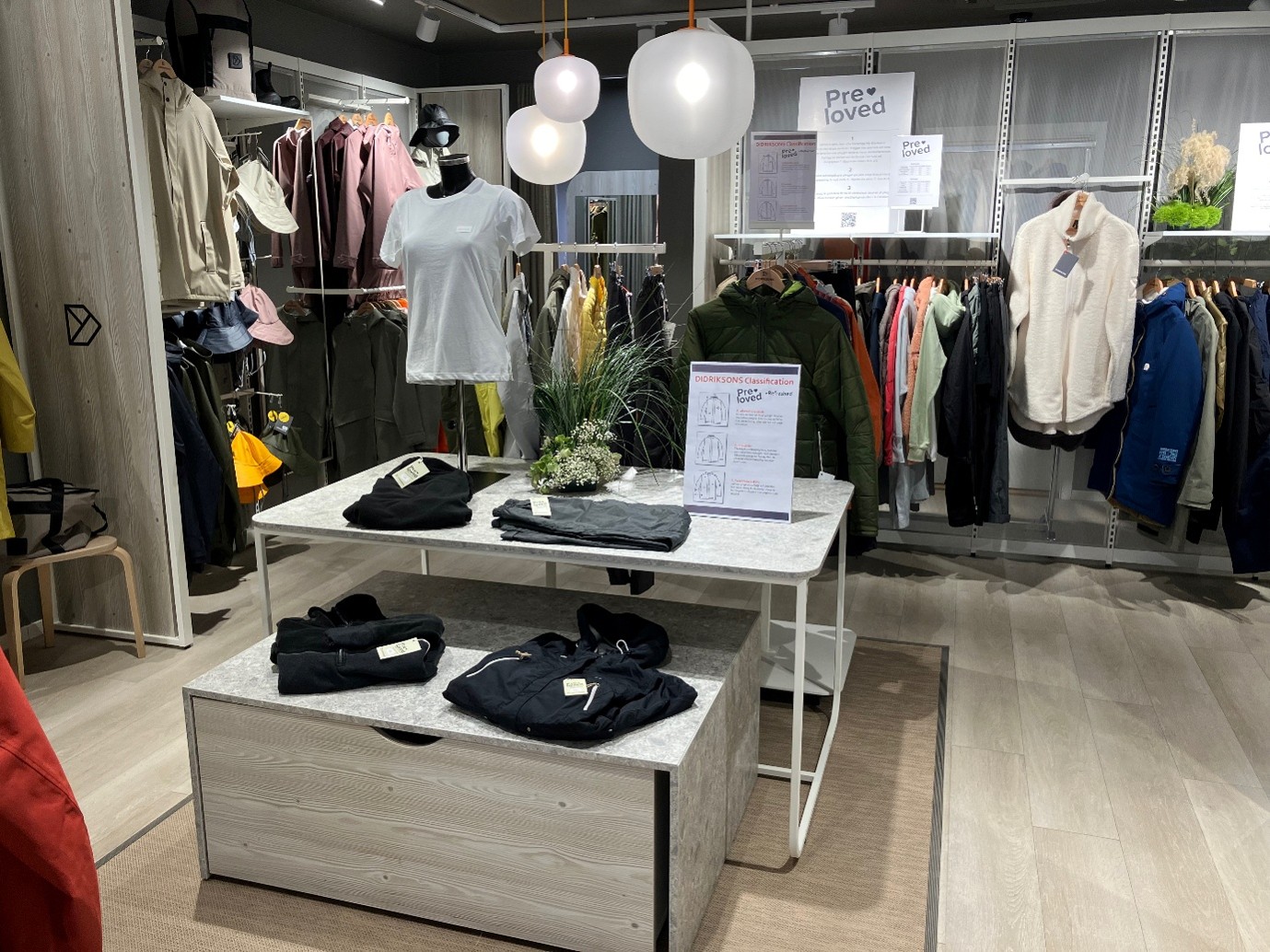
Within the framework of the Digital Business Lab, we contribute through practical tests and experiments related to consumer behavior and communication in retail environments. We have, among other things, conducted a study in a Didriksons store in Stockholm where eye-tracking glasses were used to analyze how customers respond to different types of circular offerings, such as pre-loved products and services like repair, re-impregnation, and washing. This was combined with survey studies to gain further insights into customer experiences and attitudes.
We also conduct experiments and testing together with students, where different concepts, communication solutions, and business setups are explored in a lab environment. These activities enable rapid testing of ideas and the collection of user data that can support the project’s development. More experiments and collaborations with students, including field study students, are planned for autumn 2026.
Through this combination of research and practical testing, the lab contributes to bridging the gap between theory and real-world retail, with a focus on how circular offerings can be communicated and experienced in-store in a way that creates value for both businesses and consumers.
Read more
Project time: 2025-09-15 -- 2027-09-15