


How Outdoor Retailers Integrate Repair and Second-Hand Services
2026-07-01

Abstract
Purpose — Repair and second-hand retail are increasingly central to circular economy strategies in fashion, yet little is known about whether these services are actually visible and accessible to consumers in practice. This paper examines how outdoor fashion retailers incorporate second-hand and repaired items into their physical stores and online channels, a question that matters because hidden circular services won't change consumer habits.

Design/methodology/approach
A qualitative comparative field study was conducted across three outdoor fashion retailers — Decathlon in Italy, and Stadium and Naturkompaniet in Sweden — combining in-store observation, website analysis, and informal staff conversations. Data were analysed using thematic coding, generating first-order concepts, second-order themes, and aggregate dimensions.
Findings
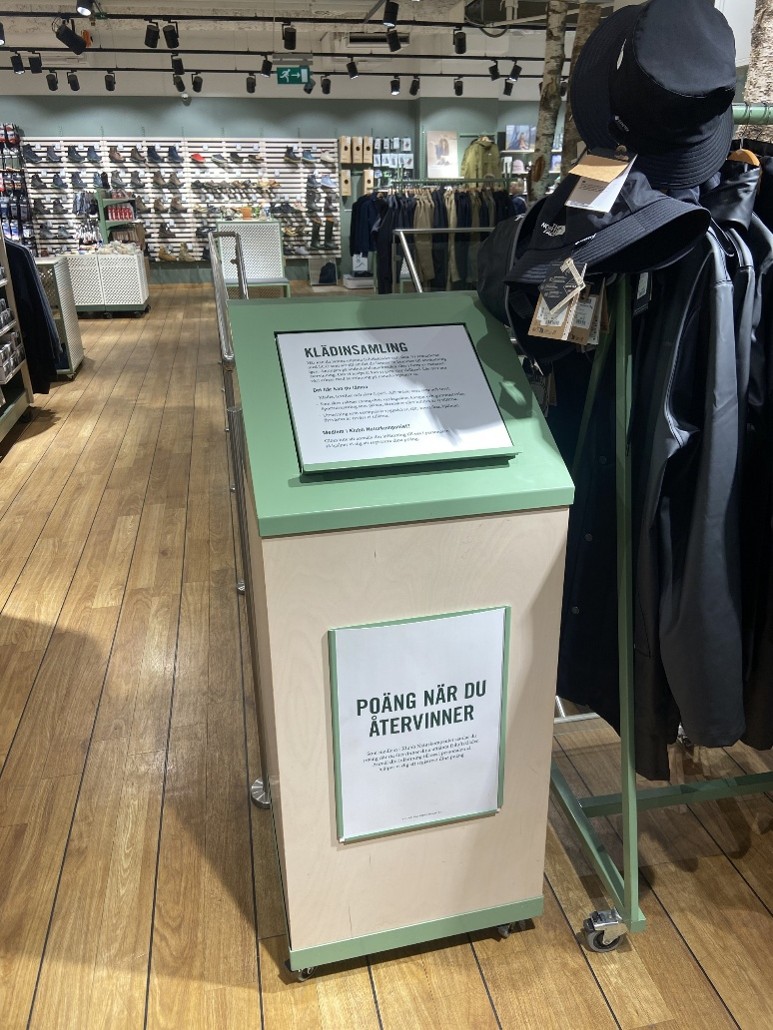
The study finds that circular services in outdoor retail suffer from two compounding problems. The first is structural invisibility: repair and second-hand offerings exist across all three retailers but are systematically underpromoted, disconnected from staff knowledge, and distributed across channels in ways that make them difficult to find. The second is a coherence gap: ambitious sustainability commitments at corporate level are rarely matched by what consumers encounter in-store, and where they are, true credibility comes from consistency, not a wide variety of offerings.
Practical implications
Retailers that have developed circular services primarily at the strategic or digital level may benefit from reviewing whether those services are adequately embedded at store level through staff training and visible in-store communication. Communicative coherence across channels and a limited number of concrete, consistently delivered initiatives appear more effective in building sustainability credibility than broad aspirational declarations.
Originality/value
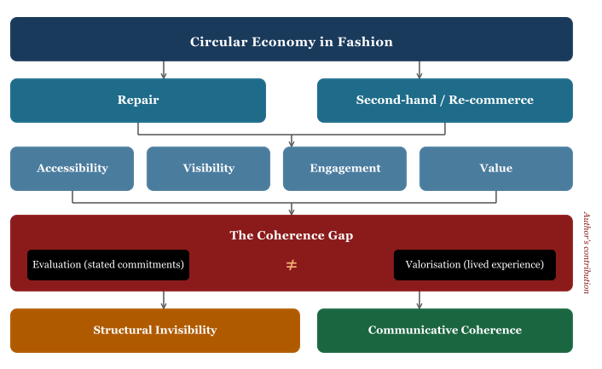
The study extends Das et al.'s (2025) framework of consumer-side repair barriers and Fuentes and Hedegård's (2025) valuation framework to the retailer level.
Using these two frameworks, this study proposes an original conceptual model that maps the coherence gap between how retailers evaluate their circular services and how consumers actually experience them, producing either structural invisibility or communicative coherence as outcomes.
Project Details
Title: How Outdoor Retailers Integrate Repair and Second-Hand Services
Tagline: Why do circular services exist but go unnoticed? This field study reveals the hidden gap between sustainability promises and the in-store experience.
Year: 2026
Language: English
Author: Enrico Quattrocchi
Course: Field Study
Type of Study: Research Assistantship - Second-Hand Retail Research
Program: Master programme Fashion Marketing and Management
Supervisor: Lars Hedegård
Enrico Quattrocchi